This article is part of our guide to Chinese medicine.
Seasons and Cycles in Traditional Chinese Medicine
Seasons in Chinese medicine: the season, element, organ and emotion framework, and what each season invites you to cultivate. A traditional frame, no promises.
Clinically reviewed by Justin Lapointe, member of the OAQ · August 8, 2026
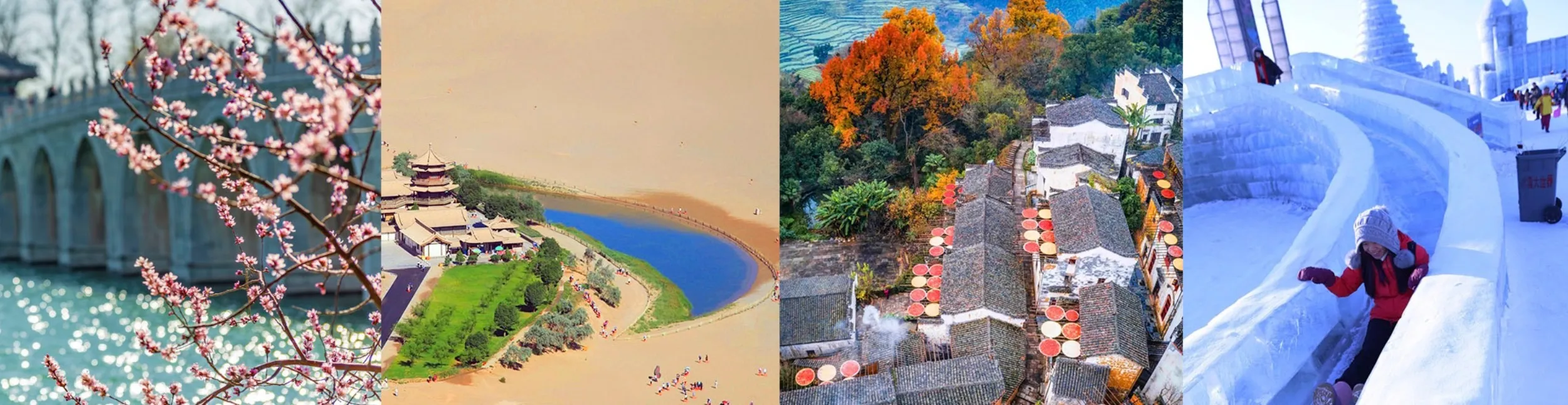
Watch a tree move through the year: sap rising in spring, the exuberance of summer, autumn’s withdrawal, winter’s silence. Chinese medicine long held that the human body replays, in its own way, the same score. From that intuition flows a whole framework (a season, an element, an organ, an emotion) and a distinctive ideal of care: not waiting for illness, but cultivating accord with the rhythms. We present it here as an inherited frame of thought, not as proof. Here is how it reads.
Book an appointment at the clinic (opens in a new tab)
The human being between Heaven and Earth: the root of the seasons
This seasonal framework is not an arbitrary list: it flows from a cosmological intuition. In the classics, the human being stands between Heaven and Earth and is woven from their breaths. “Man lives by the Qi of Heaven and Earth,” says the Suwen (chapter 25). We are a microcosm, a small world replaying at its own scale the movements of the great one: day and night, heat and cold, the expansion of summer and the retreat of winter. Health, in this frame, rests partly on our accord with those rhythms. It’s the same alternation the Yin/Yang pair describes, at another scale.
The tradition pushes this reading of time a long way: each season, and even each hour, is said to have its own quality. Caring for yourself, then, isn’t only correcting a symptom; it’s stepping back into the right tempo.
That’s where this medicine’s preventive ideal comes from. And it’s no accident of layout: the Suwen, the first half of the Huangdi Neijing, talks about lifestyle and the seasons before it talks about diseases. The order of the chapters states the order of priorities.
The seasonal cycles and the human body
Each season carries its element, its Organ and its emotion. The Suwen devotes its second chapter to this art of accompanying the year, “the great treatise on attuning the spirit to the Qi of the four seasons” (sì qì tiáo shén dà lùn 四气调神大论). You would look in vain for seasonal treatments there: these are lifestyle adjustments. Here is their spirit, season by season.
Spring (Wood, Liver). The season of rising sap. The text recommends going to bed at nightfall and rising early, walking, letting plans take shape: accompanying the movement of expansion rather than holding it back. The tradition entrusts the Liver with the free flow of Qi, and reads anger or frustration as signs that this flow is forcing its way through. It is the season, the tradition says, when that flow needs the most room.
Summer (Fire, Heart). The season of fullness. Rise early, don’t hide from the light, give joy and shared life their due, without the excess that, in this framework, agitates the Shen, the spirit housed in the Heart. An agitated Shen, in this reading, shows up on the side of anxiety and insomnia.
Late summer (Earth, Spleen). The time of ripening and of returning to centre: regular meals, moderation, attention to whatever weighs you down. The traditional Spleen dreads excess Dampness, in this model’s sense; the emotion attached to it is worrying things over, the thought that keeps circling.
Autumn (Metal, Lung). The season of shedding. Go to bed earlier, rise with the day, “keep the spirit calm and gathered,” as the text roughly puts it. The tradition links the Lung to sadness and grief, to be let pass the way leaves fall.
Winter (Water, Kidney). The season of reserve. Go to bed early, rise late, guard against the cold, don’t scatter your strength: preserve, says the tradition, what the Kidney stores. Fear is this season’s emotion, and here the table counts as much as the needle. We come back to it in nourishing the Kidneys in winter.
What holds the tradition’s attention most, in the end, is not the seasons themselves: it is their crossings. Those hinges where light, temperature and tempo change together. Some readings even place Earth there, less a fifth season than a breath between each of the others. In that logic, these are the good moments to readjust: feeding the rising sap in spring, slowing down at the door of winter.
None of this is prescriptive. And if a discomfort returns every year at the same season, medical advice comes first; acupuncture can be considered after that, among the concerns people consult for.
Conclusion
Living with the seasons rather than against them: that, at bottom, is what this framework offers. The Suwen says that waiting for illness before acting is “digging a well when you are already thirsty.” Nothing since the Han dynasty has made the image less apt. In the treatment room, this frame colours the interview and the choice of points; it decides nothing in your place.
In plain terms
In Chinese medicine, the image-laden terms (Qi, Yin/Yang, Fire, Wind, Dampness…) are conceptual and cultural landmarks: tools for thinking, not descriptions of physiology. We present them as one way of reading care, distinct from biomedical explanation, and without any promise of results.
Read next: the theory of the five elements, and the Neijing, founding text of this medicine.
A discomfort that comes back at the same season every year? Let’s have a look together. Book an appointment — in the Plateau-Mont-Royal.
In the Plateau-Mont-Royal, open 7 days a week. Acupuncturists · OAQ members, physiotherapist · OPPQ member. Insurance receipts issued on site.Our content follows a published editorial methodology.