Acupuncture for bruxism
Clenching or grinding your teeth, most often at night, without realizing it: the jaw takes it, and the neck, the temples and your sleep follow. Acupuncture works on the tension that produces the clenching, as a complement to your dental care.
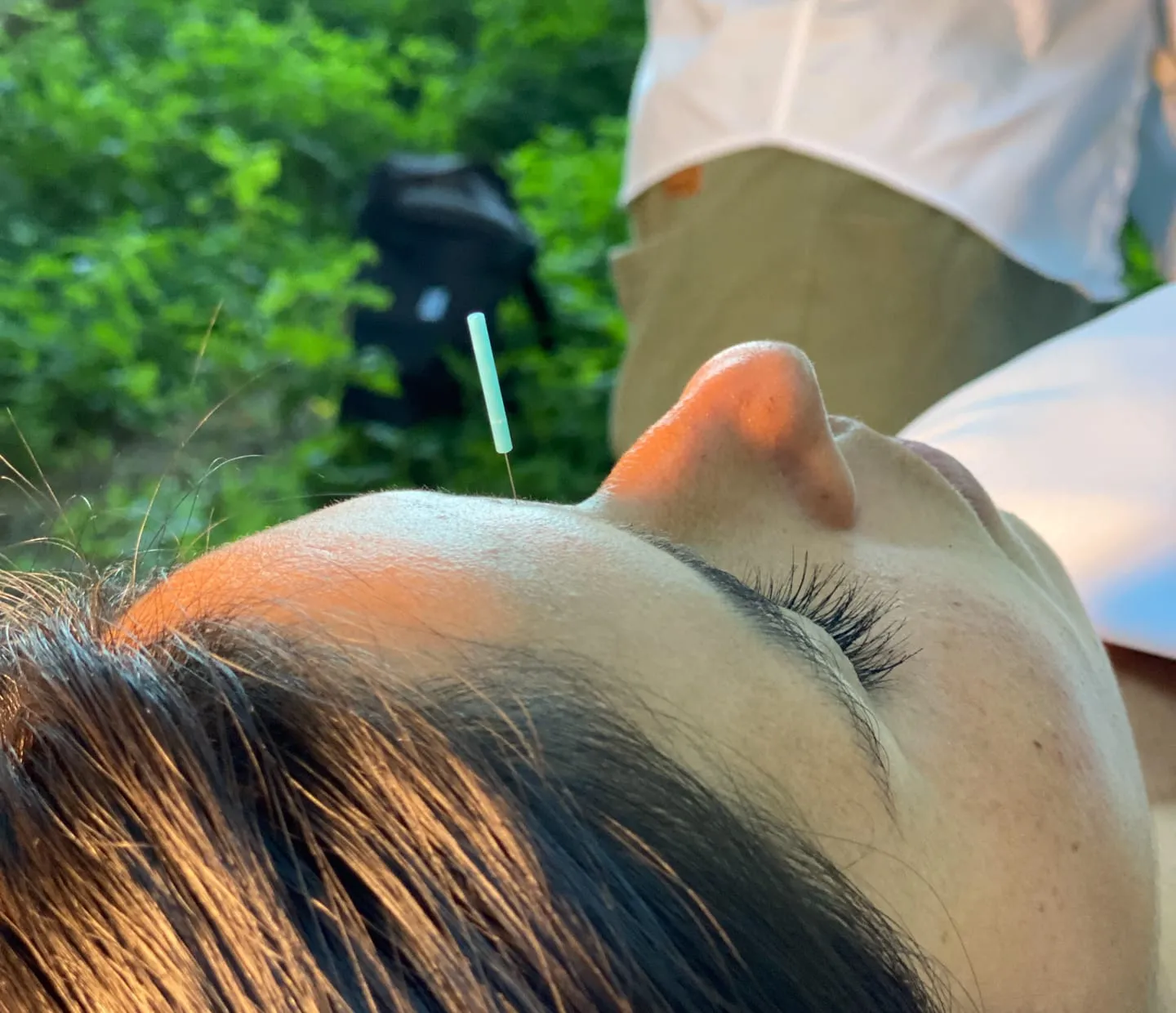
Acupuncture and bruxism: what we observe in the clinic
Bruxism (involuntary clenching or grinding of the teeth, by day or during sleep) is frequently associated with stress and with tension that builds up in the muscles of the face and jaw. In the clinic, acupuncture is used to support the release of that muscular tension and to help with managing stress, as a complement to your dental or medical care.
You almost always learn it from someone else
That’s what sets this condition apart: it happens during sleep, and the person it affects is the last to know. A dentist, someone sharing the room, or a headache that keeps coming back are what reveal it. Here are the signs most often reported in consultation.
A headache on waking
Often at the temples, there from the moment you get up, with no other obvious cause.
A tired jaw in the morning
Sore, stiff, sometimes hard to open wide on waking.
Tension in the neck and trapezius
It builds through the day and doesn’t let go with rest.
Worn or sensitive teeth
Your dentist is often the first to notice.
Grinding noises at night
Reported by whoever shares your room.
Tinnitus or a blocked ear
The feeling comes back without any hearing problem being found.
Broken sleep
Repeated waking, with no clear cause.
Three or more of these signs coming back regularly, and it’s worth talking about. Book an appointment (opens in a new tab), or raise it with your dentist first: the two kinds of care go together.
Stress, a central factor in bruxism
Stress and anxiety are factors frequently associated with bruxism, whether it occurs during the day or at night. Studies suggest that acupuncture may contribute to better stress management and, in some people, to better-quality sleep. We follow that link in more detail on our pages devoted to stress and anxiety and to insomnia.

Your dentist remains the professional who assesses and repairs the dental damage bruxism causes (wear, fractures), and who handles pain in the temporomandibular joint (TMJ). See your doctor as well if you have frequent headaches or persistent pain. Acupuncture is used as a complement to that care, never as a replacement.
What research says
The literature specific to acupuncture for bruxism remains limited and of uneven quality. A case series published in 2016 observed, in 17 adults presenting a temporomandibular joint disorder, an improvement in pain and mouth opening after dry needling sessions at the trigger points of the masseter and temporalis (Blasco-Bonora & Martín-Pintado-Zugasti, 2016 (opens in a new tab) ↗). This is a preliminary clinical observation, without a control group, not proof of effectiveness. The most solid data concern the role of acupuncture in managing stress and muscular tension in general, a better-documented area that we detail on our Stress and anxiety page. These observations do not replace dental or medical advice; each situation is assessed individually.
How a course of treatment goes
For well-established bruxism, treatment is built in three stages. The pace is not a package: it adjusts to what is observed, and it stops when it’s no longer useful.
The initial assessment
75 to 90 minutesHistory, examination of the jaw and the neck, and a look at what sets it off: stress, sleep, posture at work.
The close-spaced phase
60 to 70 minutes, once a weekClosely spaced sessions, depending on the response observed. This is the stretch over which progress is judged.
Maintenance
as neededOne session a month, or only during periods of heightened stress.
Acupuncture combines well with a night guard prescribed by your dentist, with jaw release exercises and with better sleep habits. These are approaches that add up, each on its own front.
First acupuncture visit $110 (75 to 90 minutes)Follow-up session · adult $95 (60 to 70 minutes)Receipt issued on site. All rates
Who will see you
Both are members of the Ordre des acupuncteurs du Québec and practise at the same clinic. You choose when you book, and you can switch from one visit to the next.

Justin Lapointe
Acupuncturist · ownerMember of the OAQSees patients in the afternoon and early evening.

Jessica Chan
AcupuncturistMember of the OAQMostly mornings, often within the week.
Your questions about the jaw
Does acupuncture replace my night guard?
No, the two don’t do the same job. The guard protects your teeth during the night. Acupuncture works further upstream, on the tension that produces the clenching, with no guarantee of making it go away. The two go together well.
How many sessions before I notice a difference?
A jaw that lets go is sometimes reported from the first sessions on, and it doesn’t last. For night-time bruxism, progress is judged over several weeks, with sessions close together at the start. The pace is set with your acupuncturist, with no commitment to a fixed number.
Do needles in the jaw hurt?
The needles are far finer than a blood-test needle. The masseter area can be tender because the muscle is tight; the sensation passes within a few seconds.
What if I clench during the day rather than at night?
Daytime bruxism is often linked to concentration, to screens and to posture at the computer. The approach stays the same, with a few simple ergonomic adjustments added, gone over during the consultation.
Are sessions covered by insurance?
Acupuncture care given by a member of the Ordre des acupuncteurs du Québec is often deductible as a medical expense. A receipt is issued at every session; check your coverage with your insurer.
Acupuncture for Bruxism in Montreal: Relieving Jaw Tension and Teeth Grinding
The link between stress and jaw clenching, and what acupuncture may aim for, as a complement to your dental care.
Read the article Article · SleepAcupuncture for Insomnia in Montreal: How Many Sessions to Sleep Better?
When sleep doesn’t come back, what to expect and why acupuncture is used alongside the standard approaches.
Read the articleTake the time to talk it through: initial consultation or follow-up, in person at the Plateau-Mont-Royal.