This article is part of our guide to Chinese medicine.
Acupuncture for Bruxism in Montreal: Relieving Jaw Tension and Teeth Grinding
Teeth grinding and jaw clenching: how needling addresses jaw tension and the nervous system, how many sessions, and when to see a dentist.
Clinically reviewed by Justin Lapointe, member of the OAQ · August 8, 2026
Book an appointment at the clinic (opens in a new tab)
What is bruxism?
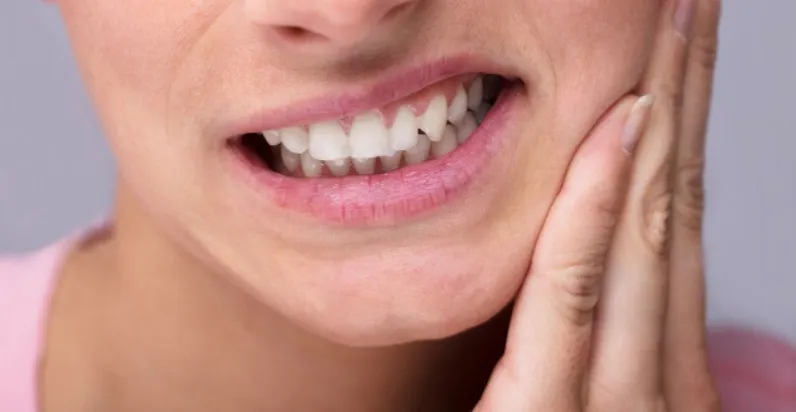
Bruxism is an involuntary jaw movement, a clenching or grinding of the teeth, that happens most often during sleep, but can also occur during the day, sometimes without you noticing. According to the Canadian Dental Association, about 30% of adults have some form of it, and most are unaware until a dentist, a partner, or a persistent headache reveals it.
It isn’t a “bad habit.” It’s a complex neuromuscular behaviour, closely linked to stress, sleep quality, and tension in the neck and face.
How to know if you have it
Here are the signs most often reported in clinic:
- Headache on waking, especially around the temples
- A tired, sore or stiff jaw in the morning
- Worn, cracked or sensitive teeth (your dentist will point this out)
- Grinding noises reported by your partner
- Tinnitus or a blocked-ear sensation
- Neck and trapezius tension that builds through the day
- Fragmented sleep with no clear cause
Several of these can coexist. If three or more recur regularly, it’s worth a consultation.
Why acupuncture can help
Bruxism is almost always driven by two intertwined factors: an over-activated nervous system (stress, hyper-reactivity, diffuse anxiety) and chronic muscle tension in the jaw and neck. Acupuncture aims to work on both at once.
On the muscles. Needling the masseter, temporalis and posterior cervical muscles can trigger a reflex release. The technique is close to dry needling for these very specific areas. The result is often noticeable as you leave the session: the jaw clenches less, the pressure drops.
On the nervous system. Distal points on the arms and legs encourage a shift of the autonomic nervous system toward the parasympathetic mode, the one for rest and recovery. That’s the side that slows the heart and encourages deeper sleep. A meta-analysis of 9 randomized clinical trials (Hamvas et al., Complement Ther Med, 2023 — PMID 36494036) observed a rise in parasympathetic tone, measured by heart-rate variability; effects on markers such as cortisol remain variable across studies. The review looks at those autonomic markers, not at bruxism going away.
That’s when the body can step out of constant alert, and the jaw, at last, can let go.
What the jaw says, in Chinese medicine
Chinese medicine looks at the same jaw differently. It’s a traditional frame, not a clinical demonstration, but its vocabulary here is strikingly apt. The masseter region is crossed by the Stomach meridian, which leaves two points with vivid names: Jiache 颊车, “the chariot of the cheek,” and Xiaguan 下关, “the lower gate.” A hinge, a gate: the very apparatus that opens and closes, that lets through or holds back.
Classical symptomatology tied teeth grinding first to Heat in the Yangming (the Stomach / Large Intestine axis), to food stagnation, to intestinal parasites, and in children to Liver Wind. What the contemporary reading adds, and what we find apt in the clinic, is the share of held-back constraint: a Liver Qi that does not move freely in someone who “clenches their teeth,” literally and figuratively. Two readings, then (the old one and ours), and it’s better to say which one you’re using. When night falls, the body lets everything go except that constraint; and if sleep stays restless, the tradition also reads a Shen, the spirit housed in the Heart, that struggles to settle. So the principle we follow: regulate Liver Qi and calm the Shen. In different words, that’s the same double front described above: the tight muscle and the inner watch. A telling image, provided you take it for what it is: a traditional reading that organizes observation, not a second proof come to confirm the first.
What a treatment plan looks like
For well-established bruxism, we usually suggest:
- Initial assessment (75 to 90 minutes, depending on the practitioner): history, jaw and neck exam, identifying triggers (stress, sleep, work posture).
- Intensive phase: four to six close-spaced sessions (60 to 70 minutes, once a week).
- Maintenance: one session a month, or as needed during higher-stress periods.
Acupuncture combines very well with a dentist-prescribed night guard, jaw-relaxation exercises, and better sleep hygiene — approaches that add up, each on its own front.
When to seek care quickly
If jaw pain stops you from eating, if mouth opening is limited, or if you hear marked joint clicking, there may be an underlying temporomandibular joint (TMJ) disorder. A prompt consultation, with us or your dentist, helps direct treatment the right way from the first session.
Frequently asked questions
How many sessions before I notice a difference?
A jaw release is sometimes reported from the first sessions; it remains short-lived. For night-time bruxism, progress is judged over several weeks, with closely spaced sessions at first; the pace is set with your acupuncturist, with no commitment to a fixed number.
Do needles in the jaw hurt?
The needles used are far finer than a blood-draw needle. The masseter area can be tender because the muscle is tight. That’s precisely the sign it needed the work. The sensation passes within seconds.
Does my insurance cover the treatment?
Many private plans recognize acupuncture on a receipt from an OAQ member; our rates are online, and coverage varies from one contract to the next, so check with your insurer. If your bruxism stems from a car or work accident, reimbursement through the SAAQ or CNESST is sometimes possible, depending on your file’s eligibility.
Does acupuncture replace my night guard?
No — the two don’t do the same job. The guard protects your teeth at night; acupuncture works upstream, on the tension that produces the clenching, with no guarantee of making it disappear. The two complement each other well.
What if my bruxism is during the day?
Daytime bruxism is often linked to concentration, screens and desk posture. Treatment is similar, with a few simple ergonomic tips added during the consultation.
To go further: discover acupuncture for bruxism at the clinic.
Book your consultation online → monacupuncteur.janeapp.com
In the Plateau-Mont-Royal, open 7 days a week. OAQ member · OPPQ member. Receipts issued on site.
In the Plateau-Mont-Royal, open 7 days a week. Acupuncturists · OAQ members, physiotherapist · OPPQ member. Insurance receipts issued on site.Our content follows a published editorial methodology.