Electroacupuncture: Mechanisms, Uses and Precautions
Electroacupuncture adds a gentle electrical current to acupuncture needles. How it works, what research explores, and what to expect in the Plateau-Mont-Royal.
Clinically reviewed by Justin Lapointe, member of the OAQ · August 8, 2026
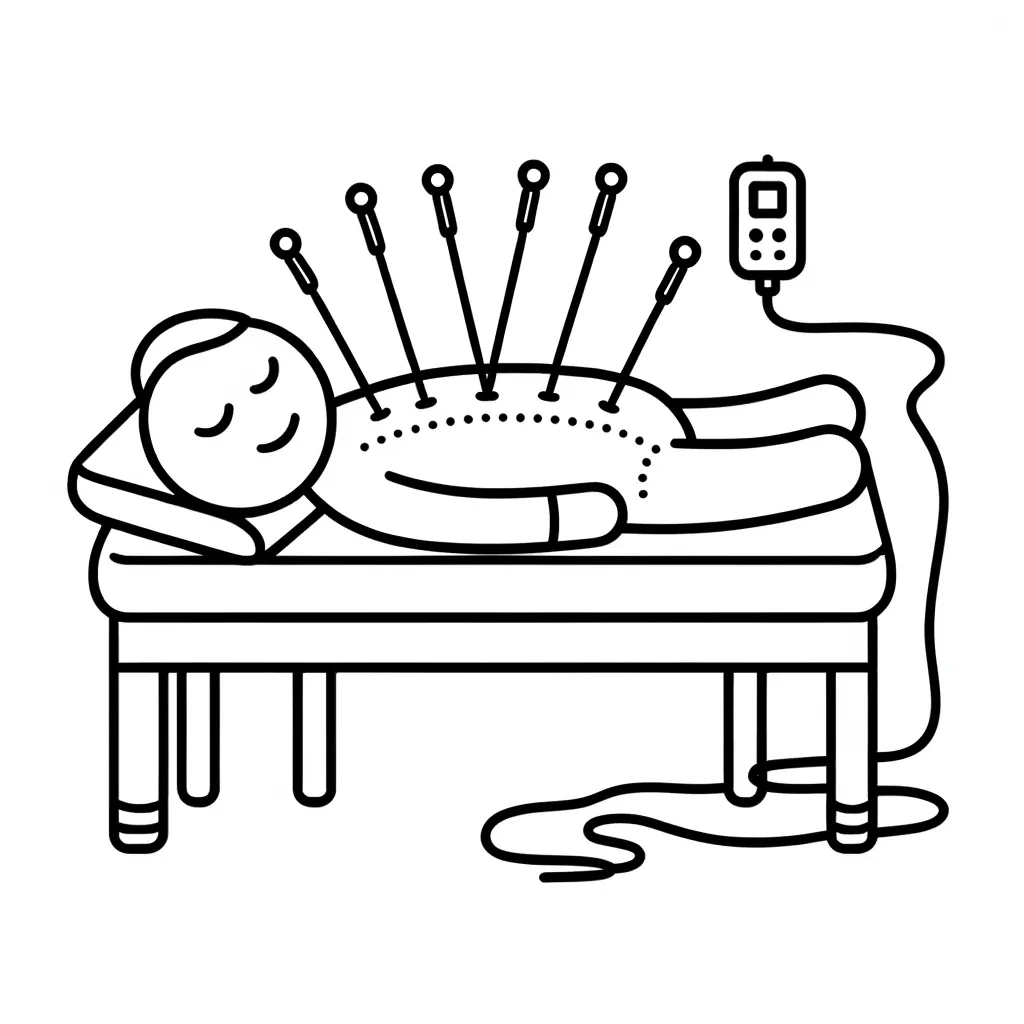
Picture a needle conceived two thousand years ago, wired to a small electrical box. That is exactly what electroacupuncture is: the oldest gesture of Chinese medicine meeting a twentieth-century technology. The needles go in as usual, then connect to a device that passes a gentle, pulsed current — in place of the hand that once turned and worked the needle to sustain the stimulation.
Nothing new about it, though: this is a technique introduced into practice in the mid-twentieth century, and today the most studied of the stimulation variants.
Frequency changes everything
The fascinating detail is a setting: the frequency of the current. Neurophysiology research — notably the work of Han Ji-Sheng’s team in Beijing (Han, Neuroscience Letters, 2004 — PMID 15135942) — has described how low and high frequencies don’t recruit the same circuits, or the same natural molecules of the body. A slow current and a fast current don’t “speak” to the nervous system in the same language. Where the manual needle already offered stimulation, electricity adds a dial: a dose that is adjustable and repeatable.
One caveat belongs here: most of this work is experimental, and a substantial part of it was carried out in animals. What holds in the laboratory does not transfer as is to the treatment room.
What research explores
Scientific research has explored the effects of electroacupuncture, notably in terms of pain relief, inflammation reduction, muscle stimulation, and effects on the nervous system. Here are a few avenues explored by research, cited as such:
- Pain Relief: Electroacupuncture is studied for its effect on chronic pain, particularly through increasing the expression of the NPS/NPSR system in the anterior cingulate cortex, contributing to the suppression of pain and pain-related anxiety (Du et al., 2020).
- Anti-inflammatory: Studies indicate that electroacupuncture may help modulate inflammation by modulating pro-inflammatory cytokines and immune pathways, with involvement of peripheral opioid systems (Kim et al., 2006).
- Muscle Stimulation: Activation of neural networks by electroacupuncture can stimulate muscles and improve their tone and strength, particularly in contexts of post-injury recovery (Arriaga-Pizano et al., 2020).
- Effects on the Nervous System: This method can also impact the autonomic nervous system, contributing to the regulation of blood pressure, digestion, and stress management (Takahashi, 2021).
In the treatment room, electroacupuncture is still acupuncture: same points, same reasoning, the current added to the needle as one more setting. One nuance is worth stating: in research, electroacupuncture protocols are most often standardized — the same points for every participant, without the pattern differentiation that defines the practice. What trials measure is therefore not quite what happens in the treatment room.
It’s used alongside usual care, where a sustained, adjustable stimulation is wanted, for instance with stubborn pain or recovery.
Precautions and contraindications
Electroacupuncture isn’t right for everyone, and that gets discussed before the session, not during it. Always tell us about:
- a pacemaker, an implanted defibrillator or any implanted electronic device — applying a current nearby is to be avoided;
- pregnancy, current or possible;
- epilepsy or a history of seizures;
- implanted metal hardware in the area to be treated (pins, plates, prostheses);
- a clotting disorder or anticoagulant treatment, a wound or a skin infection over the target area, reduced local sensation.
The current is never applied across the chest or through the head. When in doubt, manual stimulation does the job perfectly well.
In plain terms: the avenues above are research findings, reported as such — not promises of results. Electroacupuncture does not replace medical care.
Read also: Review of the physiological processes of acupuncture.
Book your consultation online → monacupuncteur.janeapp.com
In the Plateau-Mont-Royal, open 7 days a week. Acupuncturists · OAQ members, physiotherapist · OPPQ member. Insurance receipts issued on site.Our content follows a published editorial methodology.