Sports Acupuncture in Montreal: Recovery and Injury Care
Which injuries respond, how needling supports recovery, what the evidence shows (Vickers 2018, Gattie 2017), and how many sessions to expect.
Clinically reviewed by Justin Lapointe, member of the OAQ · August 8, 2026
Book an appointment at the clinic (opens in a new tab)
Which injuries respond well to acupuncture?
Sports acupuncture is mostly used for musculoskeletal injuries of mechanical or inflammatory origin. The most common in clinic:
- Tendinopathies: shoulder (rotator cuff), elbow (epicondylitis, “tennis elbow”), knee (patellar), Achilles
- Acute or chronic low-back pain: often tied to muscular tightness in the paraspinals and quadratus lumborum
- Muscular sciatica: when the piriformis compresses the nerve
- Neck and upper-back strains: typical after a hard brake, a bad night, or effort in poor posture
- Hip and glute pain: runners, cyclists, long hours seated
- Shin splints: common in runners returning to training
- Strains and ligament sprains: post-acute phase, after icing and rest
- Thoracic outlet syndrome and trapezius tension: common in musicians and stage performers
How acupuncture may act, physiologically
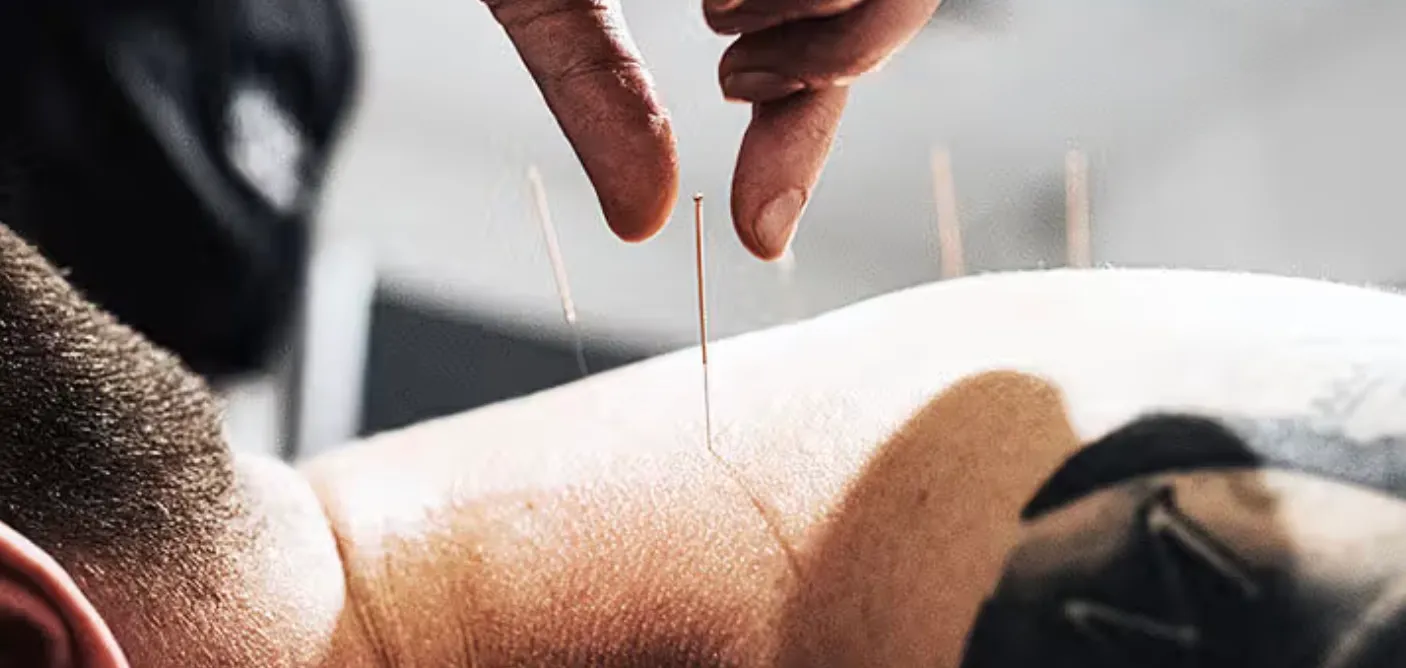
The needle isn’t a lucky charm. It’s a mechanical tool associated with several studied responses:
- Neuromuscular release: inserting a needle into a trigger point produces a brief reflex contraction (the “twitch”), often followed by release of the muscle.
- Increased microcirculation: local vasodilation improves oxygen supply and speeds the clearance of metabolic waste (lactic acid, inflammatory mediators).
- Pain modulation: release of endorphins and activation of descending inhibitory pathways at the spinal cord.
- Autonomic regulation: lowering the sympathetic tone that keeps muscles tense, and activating the parasympathetic side that supports recovery.
For chronic musculoskeletal pain, a large individual-patient-data meta-analysis of 39 trials and 20,827 patients (Vickers et al., The Journal of Pain, 2018, PMID 29198932) concludes that the effect isn’t explained by placebo alone: real but modest, about 0.2 standard deviations against sham acupuncture, about 0.5 against no treatment, with persistence at one year that decays by roughly 15%. For dry needling, systematic reviews (Gattie et al., 2017) show a short-term benefit on pain, while long-term evidence remains limited. So we stay transparent: these aren’t “alternative” medicines, but complementary approaches to physiotherapy, useful for pain and recovery.
Acupuncture, dry needling, or both?
At Mon Acupuncteur, we regularly combine the two tools depending on clinical need:
- Dry needling: to target a precise trigger point in a muscle (say, a trapezius locked up after an acute event). Fast effect, often noticeable as you leave the session.
- Acupuncture: to go beyond the muscle — regulating the nervous system, improving sleep, reducing the stress load on overall recovery, managing chronic pain.
For an athlete preparing for a competition (a marathon, a triathlon, the Montréal Rock’n’Roll half-marathon, for example), the plan usually combines a few dry-needling sessions to release accumulated tension, then acupuncture sessions in the recovery phase to optimize sleep and regeneration.
Recovery and prevention: the long game
Many athletes only come in when something hurts. Injury prevention is part of what physiotherapy and acupuncture explore with you; no approach guarantees that an injury will not happen.
One session a month during heavy training blocks lets you:
- Spot overload zones before they become symptomatic
- Maintain mobility in the muscle chains under strain
- Improve deep sleep, where most muscle recovery happens
- Keep the nervous system in a good adaptation zone, from one training block to the next
It’s a logic of upkeep, not repair. The goal is to maintain the body’s adaptive capacity across the season, without promising the absence of injury, which no approach can guarantee.
The same injury, in the classical view
Everything above describes the needle in modern language. Chinese medicine read the sports injury differently, through a theoretical frame we present as heritage, not as proof of effectiveness.
Where today we treat muscle and nerve, it long distinguished the “branch” (Biao) from the “root” (Ben). Today’s pain is the branch; but an injury that keeps coming back, that won’t consolidate, invites looking deeper: a terrain, an underlying weakness. Treating the root as well as the branch is, in an athlete’s terms, the whole difference between repairing and maintaining.
To this logic answers a signature point: Yanglingquan (GB34), below the knee, which the tradition names the “meeting point of the sinews.” Master point of the tendons, it holds a place in tendon-muscle complaints that centuries of practice have consolidated. More broadly, the tradition links the tendons to the Liver, the organ that “stores the Blood.” And the Blood, it says, flows back to the Liver during rest and nourishes the tendons. An old way of stating what every athlete knows from experience: it is at rest, and in sleep, that the body rebuilds.
None of this replaces clinical examination or the data gathered above, and none of it promises the absence of injury. But this old ground casts an interesting light on the logic of recovery and prevention that guides today’s practice.
Our clinical experience
Justin, acupuncturist, completed the Whitfield Reaves training in sports acupuncture and dry needling, a recognized reference in North American sports settings. He also taught at Cirque du Soleil for several years, which means treating artist-athletes whose bodies are pushed to extreme levels.
Josh Whelan, a physiotherapist trained at McGill University, specializes in sports orthopedics. He also regularly supports stage performers (musicians, dancers, performers) in their preparation and recovery.
The advantage of our clinic: acupuncture, dry needling and physiotherapy under one roof. We can adjust the plan quickly as you progress, without running from one therapist to another.
Frequently asked questions
How many sessions for an acute injury?
The pace depends on how old the injury is: an acute muscular injury (low-back pain, a tight muscle, early tendinopathy) is not followed the same way as chronic or recurring pain. It is set after the assessment and reviewed with you as you go. A first session lasts 75 to 90 minutes; follow-ups, 60 to 70 minutes, depending on the practitioner (see our rates).
Can I keep training during treatment?
Yes, most of the time. The goal isn’t complete rest, but managing the load during the recovery phase. We adapt the advice to your sport and your competition calendar.
Is it covered by SAAQ or CNESST?
If your injury comes from a road or work accident, acupuncture and physiotherapy may be covered by the SAAQ or the CNESST, depending on your file’s eligibility. Our receipts are issued on site.
What if my injury is months or years old?
Some people come after trying something else; others start here. Pain that lasts often sustains itself — sleep, tension, apprehension about movement; it is that whole picture the session addresses.
Do you work with other therapists?
Yes. We regularly collaborate with external physiotherapists, athletic trainers, sports physicians and chiropractors. We provide a written report on request.
Sources
- Vickers AJ et al. (2018). Acupuncture for Chronic Pain: Update of an Individual Patient Data Meta-Analysis. J Pain. — chronic musculoskeletal, headache and osteoarthritis pain.
- Gattie E et al. (2017). Trigger Point Dry Needling for Musculoskeletal Conditions: A Systematic Review and Meta-analysis. J Orthop Sports Phys Ther. — short-term benefit on pain.
To go further: explore our care in clinic.
Book your consultation online → monacupuncteur.janeapp.com
In the Plateau-Mont-Royal, open 7 days a week. OAQ member · OPPQ member. Receipts issued on site: private, SAAQ, CNESST.
In the Plateau-Mont-Royal, open 7 days a week. Acupuncturists · OAQ members, physiotherapist · OPPQ member. Insurance receipts issued on site.Our content follows a published editorial methodology.